Hybrid Compliance Training: Four Rules For Rebuilding In The Hybrid Working Era

Author:
Gary
PUBLISHED ON:
May 20, 2022
June 26, 2023
PUBLISHED IN:
Learning And Development

Compliance is like a failing relationship at most companies! Two unhappy parties, plodding through a process that, deep down, they know doesn’t work or bring them any joy.

Learners are fed-up with content that bores them to tears, and managers are close to tears being the nagging bore who demands that mandatory training is completed.

Why? Well, it’s the way compliance has always been done! The formats, the faces, the processes – they’re tried and, in our opinion, not tested enough for their suitably today.

But that’s an excuse that’ll no longer stick – because we’re in the hybrid working era now! Almost everything about how we work has moved forward while compliance has stood still (generally speaking).

Not on our watch! This blog post will help you unpick compliance and reframe it with a mindset and approach that works for today’s employees.

Here are your four rules for rebuilding compliance in the age of hybrid working:

Rule One: Compliance shouldn’t be your opening bit with a new learning platform

Your company gets a new learning platform. You gear up for launch and decide getting the mandatory compliance training out of the way is a no-brainer. It’s got to be done at some point, and that way, you can move swiftly on to the interesting stuff, right? Plus, your people will be excited now the tedious part’s out the way.

Wrong, by that point, the damage might already be done.

To truly understand why this is a bad move, let’s travel back to Christmas 1989 – months after the very first Game Boy was released.

The Game Boy lesson: A good experience trumps practicality or process

Once you’d torn open the wrapping paper and realised your Christmas wish came true, the first thought was sticking a game in and seeing what the console had to offer.

There’s no way you’re sitting down and reading the instruction manual!

The joy is in playing the game and coming back to the instructions whenever the excitement finally died down, or you couldn’t figure something out on your terms. The impact and experience of playing the game convinced you it was worth coming back to the manual and figuring it out all properly. That way, you could go again and be even better at the game next time.

Very few parents are forcing their kids to read the manual cover to cover before letting them play a game or two on Christmas morning.

The same mindset needs to be applied to compliance and learning platforms! By making it the first thing you do after launch, you are that nagging parent who insists the instructions are flicked through before you do some learning that you enjoy or makes you better at your job.

Do you really want to be the L&D Grinch?

Probably not! So what if we flipped that traditional approach on its head and made L&D level one about content that makes a difference and not your people disinterested. That leads us nicely to Rule Two:

Rule Two: Compliance shouldn’t be the heartbeat of your learning culture

Many companies have compliance-driven learning cultures, and you could be one of them!

Learning at these organisations is often about forcing people to complete mandatory training, first and foremost. Giving people new skills or the knowledge to overcome business challenges and truly make a difference are afterthoughts or never even thought about.

This essentially drives a train through L&D’s reputation, influence and credibility in the business.

What if I have a compliance-driven learning culture!?

An easy test is asking people what comes to mind when you mention learning and development. If their response is an anecdotal story of being chased up to complete some kind of mandatory training, that’s a telltale sign of a compliance-driven learning culture.

Essentially, you’ve got a massive PR issue on your hands. Neither learners or leadership view L&D as a valuable contributor to solving business challenges, meaning they won’t see the value in engaging with you or your initiatives.

So you can kiss goodbye to learner engagement and a seat at the executive table. That’s how damaging a compliance-driven culture can be…

What’s the alternative? Moving towards a performance or impact-driven culture

Nobody’s denying that compliance is critical, but we need a re-jig of our priorities and the timelines for which types of learning and training we implement.

Like our Game Boy scenario, our priority has to be helping people solve real challenges and have an impact in doing so. That not only helps people get better at their job and overcome hurdles that prevent them from doing so, it shows them the value in learning. Meaning they’re more likely to do it again!

And if the senior leadership team are seeing L&D’s influence in solving problems and developing people, you’re more likely to get that seat at the table.

Rule Three: Forget everything you thought you knew about compliance

If there was ever a rulebook that needed ripping up, it’s the compliance one! Too many people follow the way things have always been done, and too few are questioning why and whether it actually works for them.

Mind-numbing click-through courses. Ridiculously long content. Rolling out a tsunami of content to absolutely EVERYBODY in the company. Everyone who’s completed mandatory training knows the struggle, so it’s time we gave L&D the wake-up call it needs and re-shape it for remote working and hybrid employees.

Here are the common bugbears or questions your employees might be too polite to tell you about.

Our compliance content’s too long and too boring

There’s no sugar coating it, a lot of compliance is built around boring topics. At the same time, it’s pretty damn important, and there’s a lot to cover. That’s how we end up with incredibly long compliance content.

Research has revealed that 70% of compliance is over 30 minutes long, while people want bitesize content that comes in at the 20-minute mark or under.

Surely this can’t be the best format?

If you’ve ever done of these very long compliance courses, you’ll have probably encountered the ‘click next slide’ format. Wondering if there will ever be an end to the next slides or if this is simply your life now.

It might also be a next video or next recording format, but the point still stands that this repetitive content is not warmly received by learners.

34% say that they only skim-read content or tune out for video and audio. 15% bluntly revealed that they click through without reading or listening to the content.

  1. Speak to your people and understand the formats that work best for them.
  2. Recognise that you can achieve consistency while using different content.

Meet HowNow+ 👋 The best learning content in one single subscription

A common misconception is that in order to achieve compliance and consistency everyone has to complete the exact same compliance training course from the exact same provider.

It’s entirely feasible to use video content from one provider and microlearning resources from another. But it’s rarely practical. You’re managing compliance in two different places, with two invoices to pay, two processes to manage and two sets of reports to cobble together.

HowNow+ The best learning content, one single subscription

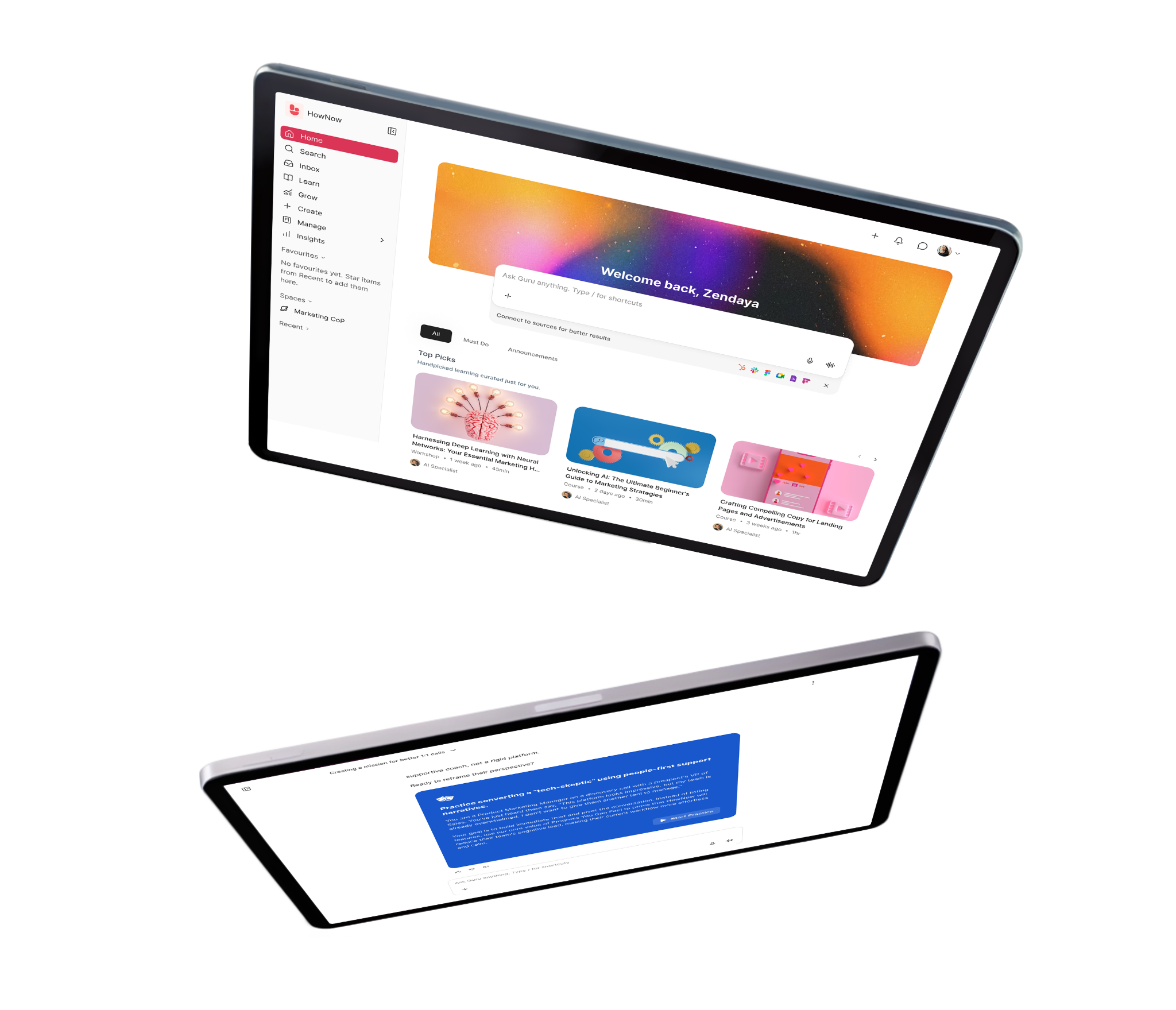
HowNow+ offers you handpicked resources, for business-critical topics, from expert providers in one single subscription and one single platform. Meaning you can achieve that compliance dream of combining multiple resources with seamless delivery and reporting.

Why am I seeing this? It doesn’t seem relevant

Only 45% of employees feel their company’s compliance training is specific to their team or role. That’s worrying close to half!

Too often, compliance content is rolled out to everyone who *might* be relevant rather than taking the time to work out exactly who it’s relevant for.

And if people are spending time on content with all the issues we’ve discussed above, AND it’s not relevant, learner engagement takes another hammering.

Is this going to help me later? And where can I find it?

When compliance content is relevant, there’s a fair chance people will want to visit it on-demand later on. They might need a refresher, to quickly confirm something or help a colleague clarify a point.

But if they’ve just scrolled through 79 slides of course content, you can’t blame them for being sceptical about whether A) they’ll be able to find it later and B) the format will help solve their problem speedily.

Often, compliance doesn’t stop at completion. So think about where you’re going to store that content later, how you’ll organise it and ways you can signpost it to your employees.

Rule Four: If you’re an L&D admin, make the admin easier for yourself

For too many managers, the compliance process is a painstakingly manual one. They’re keeping a record of who’s completed it, sending reminders to anyone who hasn’t and constantly trying to keep it all updated.

Firstly, that’s not a good use of their time. Secondly, it hardly makes them popular with employees. Too often, blanket reminders are sent to everyone, even people who’ve already completed the training at hand.

And we don’t want you being unpopular or stressed under a mountain of manual work! Especially if you’ve got remote teams, lots of hybrid working, and can’t add the in-person touch to negate the hassle of being chased up for compliance.

Let HowNow manage the manual parts and keep you on top of compliance

Here are a few ways we’ll make compliance a far more efficient and enjoyable process for you:

Automate the reminders

If you set a completion date for a course, we’ll take care of the follow ups for anyone who hasn’t completed it. In the weeks and day running up to it and into the overdue notices for when the deadline’s passed (while notifying you that it’s happened, of course).

Set custom rules for recurring content

Chances are you’ll be completing elements of your compliance training on a recurring basis – most commonly this is a yearly requirement for things like health and safety, anti-money laundering or GDPR.

If that’s the case, simply switch on our recurring course option and set a timeframe for when it needs to be repeated after completion. We’ll take care of the rest, giving you back the time and energy you’d typically spend on recurring compliance content.

Recurring Dates feature to manage compliance and repeating courses

Report in real-time

When you are dealing with those crucial compliance topics, it’s incredibly useful if you can understand completion in real-time. That’s what we offer! In-the-moment snapshots of completion rates and the ability to understand who’s still outstanding in a matter of clicks.

Want to see how you can rebuild compliance using HowNow? Book a demo, and we’ll show you how!

Check out our other compliance training resources

Want a 5x better engagement than a traditional LMS
Demo Hownow

Be in the know

More articles

Overview: Based on reviews from learning platform users, Sana Learn is praised for its intuitive interface, easy adoption, engaging interactive content, and AI-powered tools that can speed up content creation and discovery. Customers consistently highlight smooth onboarding, responsive support, and useful integrations with email, calendar, and collaboration tools. However, recurring limitations emerge around content flexibility, AI accuracy, occasional technical glitches, UI quirks, and gaps in admin training, which can create friction as teams scale their learning programs. While Sana Learn works well for organisations seeking fast rollout and straightforward learner engagement, teams needing more customization, reliable AI, and robust integrations may want to explore alternative platforms and see how they compare in practice.


When you're evaluating learning platforms, everyone has an opinion. Vendors have feature pages. Review sites have listicles. And everyone claims to be the best AI-powered LMS on the market.

What nobody tells you is what it's actually like six months in.

Sana Learn (part of Sana Labs), an AI company founded in 2016 in Stockholm, will likely show up early in your research. It's well-funded, well-marketed and has built a genuine reputation in the AI learning space.

But reputation and reality don't always match. And the people best placed to tell you the difference aren't the sales team. They're the L&D leaders, admins and learners who use it every day.

To help you, you’ve analysed 50+ real customer reviews so you don't have to. Not to cherry-pick the bad bits but to find the patterns that will help you make informed decisions. The things that come up again and again once the implementation is done and the day-to-day reality sets in.

Because when you're making a buying decision that affects your entire workforce, what matters isn't which platform has the best copy or demo. It's which one that will help you build and engage your workforce to proactively build the skills your business needs to grow.

Where Sana Learn does well.

One thing becomes clear when you read through the customer reviews: Sana Learn is easy to like.

Users consistently describe the platform as intuitive, clean and simple to pick up. There's very little friction in getting started which, if you've ever tried rolling out a new learning platform to a sceptical workforce, you'll know is no small thing.

That ease extends to implementation. Several reviewers highlight how seamless the setup felt, with teams barely noticing the transition. For organisations without the time or appetite for a heavy rollout, that's a meaningful advantage.

AI is another area where Sana Learn gets genuine praise. Users point to how quickly they can generate content, surface answers and navigate learning materials with AI woven throughout the experience. When it works, it removes friction from the content creation process in a way that L&D teams with limited resources will appreciate.

The learning experience itself also lands well. Interactive modules, clickable elements and embedded content make it easier to engage with topics that would otherwise feel dry. Learners aren't just clicking through slides; they're actually interacting with material.

Put simply: Sana Learn is a platform that's genuinely easy to adopt and easy to engage with. For teams prioritising simplicity and fast time-to-value, that counts for a lot.

What are the limitations of Sana Learn?

Once you move past first impressions, the reviews become more nuanced; and more useful.

A recurring theme is that while Sana Learn is easy to use, it can feel limiting when you try to do more with it.

Several users point to a lack of flexibility in content creation. Editing options are described as restrictive, with one reviewer putting it plainly:

"Tables are a bit clunky and hard to edit… [there's not] much freedom when it comes to text & layout."

Others mention having to rely on external tools to get the output they actually need:

"Many features are unavailable and have to be done outside of the platform using third-party providers."

For L&D teams trying to scale content production or tailor learning experiences more precisely, that's where friction starts to add up.

There's also a subtle but telling critique around product direction. One reviewer notes that the platform sometimes prioritises:

"attention-grabbing features over more basic feature development."

That's the kind of comment that tends to surface when a platform is evolving quickly; but not always in the direction its users need most.

Is Sana Learn's AI reliable?

AI is one of Sana Learn's biggest selling points; but it's also one of its most inconsistent areas.

While some users are impressed by the speed and convenience, others highlight accuracy issues that slow them down rather than speed them up:

"There are times when the AI doesn't fully grasp what I'm asking for…"

"Sometimes the AI suggestions are not fully accurate, and it takes a bit of time to find the exact content I'm looking for."

That tension shows up across multiple reviews. The capability is there; but it's not always reliable enough to trust without sense-checking.

For L&D teams expecting AI to meaningfully reduce manual effort, that gap matters more than it might first appear.

What do Sana Learn users say about technical performance?

Another pattern across the reviews is the presence of ongoing, low-level technical friction. Not catastrophic failures; but enough to interrupt workflows when they matter most.

Users mention occasional platform freezing, performance lags when handling complex content and integration challenges, particularly around APIs. One reviewer sums it up plainly:

"The platform can be a bit glitchy at times…"

Others call out specific integration issues:

"Had some hiccups with [the] Bamboo integration API."

These aren't universal experiences; but they appear frequently enough to be worth factoring in, particularly for organisations running a broader HR and L&D tech stack where reliable integrations aren't optional.


What do Sana Learn users say about the interface?

Interestingly, even though usability is one of Sana Learn's most praised qualities, there are still consistent complaints about specific interface behaviours; particularly once users move beyond everyday tasks.

For example, one reviewer points out a frustrating content creation issue:

"When I'm creating a comment… and then pop over to another window, the comments I started typing disappear."

Others find the home screen experience overwhelming:

"The interface can appear a little overwhelming with all the videos visible when you enter the homescreen."

There are also mentions of difficulty navigating back to in-progress courses, and issues with live learning environments around audio and visual quality.

None of these are deal-breakers on their own. But together they create a sense of inconsistency; where the platform feels smooth in some moments and frustrating in others. For L&D teams managing large learner populations, those friction points tend to get amplified at scale.


What do Sana Learn users say about the learning experience?

Beyond the platform mechanics, some users point to limitations in how learning content is actually delivered.

Quiz functionality comes up more than once, particularly around rigid structures:

"When making a mistake… you have to click through the whole exam before being able to repeat."

Others mention repetitive questions and a lack of depth in supporting materials:

"Example videos are not very detailed enough."

There's also feedback around pacing; specifically that learners can move through content too quickly without meaningful controls in place to slow them down or check understanding along the way.

None of these are headline issues. But for L&D teams where learning effectiveness is the whole point, they're worth knowing about before you buy.


What do Sana Learn admins say about the platform experience?

While learners tend to find Sana Learn straightforward, the experience for admins and L&D teams is less consistently praised.

Some reviewers highlight a lack of guidance when it comes to more advanced features:

"Need more training on available features."

Others point to documentation that doesn't quite hit the mark:

"Videos are usually very short and articles can be text heavy."

This creates a meaningful disconnect. The platform feels simple on the surface; but getting the most out of it as an admin can require significantly more effort than the initial experience suggests. For L&D teams who need to move fast and can't afford a steep learning curve behind the scenes, that's worth factoring into your decision.


Should you be looking at Sana Learn alternatives?

That depends on what you need.

If your priority is fast rollout, strong initial engagement and a clean intuitive interface, Sana Learn clearly delivers. For teams that need something up and running quickly with minimal friction, it's a strong option.

But if you're thinking longer term; about scaling learning, tailoring content more precisely and integrating deeply into your wider HR and L&D tech stack, the limitations that surface across these reviews start to matter a great deal more.

The question isn't whether Sana Learn is a good platform. For many organisations, it is. The question is whether it's the right platform for where your organisation is going; not just where it is today.

Is HowNow a good Sana Learn alternative?

HowNow tends to come up for teams that want more than a clean learning interface.

Reviews give you a strong starting point but they won’t tell you how a platform fits your specific setup.

If you’re weighing up Sana Learn against alternatives, the most useful next step is to see them side by side.

HowNow built around a different idea: that learning shouldn't sit in a separate platform, disconnected from the way people actually work. It should connect everything together; the content, the skills data, the performance context and the tools your teams already use every day.

In practice, that means bringing learning from multiple sources into one centralised place, linking development directly to skills gaps and business performance, and using AI in a way that supports real workflows rather than just speeding up content generation.

But perhaps most importantly, HowNow is designed to scale with you. Not just easy to start; but built to deliver more as your organisation grows, your needs get more complex and your expectations of what good learning looks like get higher.

If the patterns in these reviews resonate with challenges you're already facing, it might be worth seeing it for yourself.

👉 Book a demo here

Sana Learn Reviews: Pros, Cons & What Customers Really Think

Based on 50+ customer reviews, this guide breaks down Sana Learn’s pros, cons, AI capabilities and platform limitations. Discover what real users say about usability, integrations, support and whether it’s the right fit for your L&D strategy.
Comparisons
Apr 10
.
5 min read

Buying a learning platform is a big decision.

You’re comparing features, pricing, integrations, and user experience. But there’s one thing that often gets pushed down the list is security.

It shouldn’t be.

Learning platforms sit on a goldmine of sensitive data e.g. employee records, performance data, personal details. If that data is mishandled, the impact isn’t just technical. It’s reputational, legal, and operational.

So before you get dazzled by a slick demo, it’s worth asking more important questions such as:

Is this platform safe? And can I trust this vendor?

Why security matters when buying a learning platform

Security conversations are often left until the final stages of evaluation.

By then:

  • Data has already been shared
  • Internal stakeholders are invested
  • Walking away feels expensive

That’s how risky decisions get made.

Instead, bring security into the conversation early.

Loop in your InfoSec, IT and data protection teams from the start so they can review vendors alongside you (not play catch-up at the end which is what we often see).

It saves time, avoids friction, and builds confidence internally.

What security certifications should an LMS or LXP have?

There are plenty of badges vendors can display.

Not all of them mean the same thing.

When it comes to learning platform security, there are two certifications that actually matter:

ISO 27001:2022 — The Global Standard

ISO 27001 is a globally recognised information security standard.

It’s a risk-based framework that shows a vendor takes security seriously across their organisation (not just in isolated areas).

But this is where many buyers stop too early.

The certificate alone isn’t enough.

Ask for the Statement of Applicability (SoA).

This document shows:

  • which controls are implemented
  • how risks are managed
  • why specific decisions were made

When reviewing it, pay close attention to:

  • information classification
  • data leakage prevention
  • handling of personally identifiable information (PII)

Learning platforms process large volumes of employee data. If a vendor can’t clearly explain how that data is segmented and protected in their cloud environment, the certification doesn’t mean much.

What to double-check

  • Does the certification cover the whole organisation or just part of it?
  • Is it officially accredited?
  • Is it the vendor’s certification, or are they pointing to their hosting provider (AWS, Azure, etc.)?

If it’s the latter, push back. Hosting infrastructure doesn't mean application security.

Cyber Essentials Plus — Essential for UK-based organisations

If you’re a UK-based company, Cyber Essentials Plus should be your baseline.

Unlike the standard Cyber Essentials (which is self-assessed), the Plus certification includes:

  • independent technical verification
  • hands-on testing
  • real validation of controls

For a learning platform handling sensitive employee data, this provides confidence that the basics are properly secured.

As with ISO 27001, don’t just take it at face value.

Verify it:

Security checklist for evaluating any LMS vendor

Even with the right certifications, you should go further.

Here’s a simple checklist you can use internally or share with your IT team:

Before approving a learning platform, confirm:

  • ISO 27001:2022 certification (with SoA available)
  • Cyber Essentials Plus (if UK-based)
  • SSO support (e.g. Okta, Azure, Google)
  • encryption at rest and in transit
  • data classification and leakage prevention controls
  • penetration testing summaries
  • disaster recovery and business continuity plans
  • incident management and breach response policies
  • data processing agreement (DPA)
  • subprocessor transparency

If a vendor struggles to answer these clearly, that tells you something.

Questions to ask your LMS vendor

If you want to quickly separate strong vendors from weak ones, ask:

  • Can you share your Statement of Applicability?
  • Does your ISO 27001 certification cover your entire organisation?
  • How do you protect PII within your platform?
  • How do you prevent data leakage in your cloud environment?
  • Can you verify your Cyber Essentials Plus certification?
  • Is your certification your own, or your hosting provider’s?

HowNow’s approach to learning platform security

At HowNow, security isn’t an afterthought. It’s built into every layer of the platform.

We’ve designed our approach to make life easier not just for L&D teams, but for IT and security teams reviewing us too.

Our compliance framework includes:

  • ISO 27001:2022 for information security management
  • ISO 9001:2015 for quality and continuous improvement
  • Cyber Essentials Plus for independently verified technical controls
  • GDPR compliance and data protection standards
  • NIS2 readiness and evolving regulatory alignment

We also provide full transparency through our Trust Center, including:

  • encryption standards (including AES-256 at rest)
  • SSO and identity provider integrations (Okta, Azure, Google, etc.)
  • penetration testing summaries
  • vulnerability management policies
  • disaster recovery and business continuity plans
  • subprocessor details and data handling practices
  • AI security and ethics policies

👉 Explore the HowNow Trust Center: https://trust.gethownow.com/

This gives your IT and security teams everything they need to evaluate us properly without delays or back-and-forth.

The bottom line:

A great learning platform should help your people perform better.

But it also needs to earn your organisation’s trust.

Security credentials might not be the most exciting part of the buying process but they’re one of the most important.

The right certifications, combined with real transparency, give you confidence that your data is protected and your decision is sound.

Bring your IT team into the conversation

If security is slowing down your buying process, you’re not alone.

The easiest way to move forward is to involve your IT and security teams early and give them direct access to the information they need.

Share our Trust Center with them or book a call with our team to review everything together.

No chasing. No vague answers. Just clear, honest security information.

Which Infosec Credentials Should You Look for When Buying a Learning Platform?

Blog
March 30, 2026
.
5 min read

Learning Technologies is back and we could not be more excited.

L&D is changing faster than most organisations can keep up with. AI is reshaping how people learn, skills gaps are widening and the pressure on L&D teams to prove impact has never been higher. The conversations happening at this year's event are going to matter.

HowNow is already working with companies to build the talent of tomorrow; closing skills gaps, connecting learning to performance and giving L&D teams the data to prove it's working. We want to help you do the same.

Learning Technologies is a great place to start this journey.

You'll find us at stand E30. Come and find us.

Here's what's waiting for you.

1. Get a Free Learning Health Check

Most L&D teams we speak to already know something isn't quite working. Maybe engagement is low. Maybe learning is scattered across too many tools. Maybe the business is asking questions about impact that are hard to answer.

The Learning Health Check is a free 15-minute desk-side consultation with one of our experts at stand E30. No slides, no sales pitch; just a focused conversation about where your organisation is right now, what's getting in the way and where the biggest opportunities are.

You'll walk away with tips you can apply to your strategy straight away, whether you use HowNow or not. This is exclusive to Learning Technologies and designed to be relevant to you and your organisation.

Prebook your session here for your chance to also claim some exclusive swag.

2. Hear How to Prove Learning Is Actually Building Skills

Day one. 1:10pm. Bitesize Stage

If you've ever sat in a leadership meeting struggling to demonstrate the impact of your learning programme, this one's for you.

Harvey Stead is taking the stage for a bitesize session on one of the biggest questions in L&D right now: how do you prove that learning is genuinely building skills? Join a group of 30+ L&D leaders for a practical, focused conversation designed to give you something you can actually take back to the business.

Arrive at 1pm to secure your seat. Spaces are extremely limited and assigned on a first-come, first-served basis.

3. Learn What It Means to Be a Self-Improving Company

Day one, 11:45–12:15pm in Theatre 2. 

Day two, 11:45–12:15pm in Theatre 2. 

Every company wants the same thing: people continuously getting better at their jobs. But running that loop manually is nearly impossible. Who's struggling? When do you intervene? What actually helps? Did it work? By the time you've coordinated answers to those questions, months have passed and the moment is gone.

In this session, Nelson Sivalingam; CEO of HowNow, one of the fastest-growing AI learning companies and author of the acclaimed book Learning at Speed; introduces a fundamentally different model: the self-improving company.

Nelson will show how AI agents are transforming organisational performance by monitoring work systems in real time, detecting struggles the moment they emerge, intervening with the right support at the right time and measuring what actually improved in performance data; not surveys.

So popular we are running it twice. No excuses to miss it.

4. Hear Trainline’s Approach to Employee Engagement

Day two, 14:45 – 15:15 in Theatre 2. 

Building a learning culture sounds great on paper. Doing it in reality? That’s where things get interesting.

In this honest fireside chat, Trainline shares how they’re approaching employee engagement from the ground up; what’s worked, what hasn’t and where they’re still experimenting. From driving early adoption to making learning feel genuinely relevant across the business, this session goes beyond theory and into the real challenges L&D teams face every day.

Expect practical insights you can take back with you, along with a clear view of what it actually takes to get people engaged in learning.

If you're trying to increase learning engagement, bring a notebook.

5. Meet HowNow Customers at Our Happy Hour

Day one, 15:00 onwards - Stand 30. 

Straight after Nelson's session, we're hosting a customer meet and greet at stand E30. Prosecco, canned cocktails, beers and the kind of conversations you actually come to events like this for.

Want to know what it's really like to use HowNow? Don't ask us. Ask them.

Look out for the special 'talk to me' badges; those are the HowNow customers with the real stories. They'll be in and around the stand all afternoon and they're easy to spot. Pull them aside, ask them anything and hear first-hand what's working for organisations just like yours.

6. Get refreshed with us

And if all that wasn't enough, we’ll also have fresh coffee flowing and soft serve ice cream on hand too; because balance is important.

Whether you need a caffeine boost, something sweet, or just a reason to pause between sessions, it’s the perfect excuse to stop by and have a relaxed chat with the team. No agenda, no pressure; just good conversation (and better snacks).

The best moments at events like this aren’t always on stage. Sometimes they’re over a coffee… or an ice cream, but either way, they are together.

And so many more reasons….

So, whether you want to catch a talk, grab a drink, or just have a proper conversation about your learning strategy, we'd love to see you. Learning Technologies is one of the best opportunities of the year to connect, learn and get inspired and we're making sure our stand is worth your time.

See you there.

6 Reasons to Visit HowNow at Learning Technologies 2026

Blog
March 18, 2026
.
5 min read

Onboarding is one of those things everyone agrees matters and yet it’s still one of the most inconsistently done processes in most organisations. Too often it’s a chaotic first week of back-to-back meetings, a SharePoint folder nobody can find, and a laptop that arrives three days late.

Designing onboarding that actually scales is one of the biggest challenges HR and L&D teams face. Most organisations know their onboarding could be better. 

Pauline Taylor, VP of People at HowNow, spoke with Ian Walker on the L&D Disrupt Podcast about what great onboarding really looks like and how to build it properly.

This blog walks you through what came out of that conversation and where to start.

Why Onboarding Matters More Than You Think

Let’s start with the business case, because it’s a strong one.

As Ian puts it:

“The value, of course, is that you are accelerating people’s sense of connection. And the statistic about that is that if people feel that they have been treated well in the onboarding process, their longevity is extended. So from a retention point of view, the evidence is pretty unequivocal.”

Connection drives retention. If a new hire spends their first few weeks feeling lost, anxious, or like an afterthought, you’re already on the back foot, regardless of how good the role is. Good onboarding accelerates that sense of belonging and gets people up to speed faster. Friction in those early weeks doesn’t just feel bad. It costs you time, productivity, and ultimately, people.

Want to learn how to create an onboarding process? Check out this blog on how to create an onboarding process.

Should Employee Onboarding be In-Person vs. Remote?

There’s no universal answer here, but there are some useful principles.

If you’re onboarding in person, you’re making a strategic investment in culture. Salesforce, for example, made in-person onboarding a priority specifically because they believed it was the best way to embed culture from day one. That’s not a logistical decision; it’s a values one.

If you’re onboarding remotely, the goal is to make the experience feel as close to in-real-life as possible. As Ian says:

“Similarly, if you’re doing it remotely, make sure that all of the experience is as far as possible close to the in real life experience.”

The principles are the same: connection, culture, and clarity. The delivery just looks different.

Nail the Employee Onboarding Fundamentals

This one sounds obvious, but it’s where so many onboarding programmes fall apart.

If you’re bringing someone in person, the infrastructure has to be invisible. Ian is direct on this:

“If you’re gonna do it in person, make sure that all of that is properly handled and does not come back onto the individual. Not only will that distract them, it’ll make them more nervous, it’ll make them feel less good about the whole experience. But it will detract from the efficiency of ramping them up quickly as well.”

That means flights and hotels booked correctly, a laptop ready on day one, security badges sorted in advance, and schedules organised. Get the admin right, and everything else has a chance to land.

What Should Actually Be In Your Onboarding Programme?

Your company culture is the most important element of any onboarding programme. Don’t just list your values on a slide and move on. Bring them to life.

Ian’s advice here is clear:

“Bring in managers, bring in people who are living the culture. So it’s not just someone listening to the same person, same voice all day. You’re getting different voices in there, but you’re getting people sharing their lived experience of why is this culture important to me?”

When people share their lived experience, it lands differently. It’s personal, it’s real, and far more memorable than a PowerPoint.

Networking opportunities

When you’ve got a cohort of new starters in a room (or on a call) that’s a real opportunity. Ian puts it well:

“Use this opportunity to build your network as well. Understand what’s happening within the company because not only will you leverage those relationships, but you’ll learn about what are potential career paths that you can also follow?”

Build in time for people to actually connect with each other. Those relationships can shape how people collaborate and grow within the organisation long after onboarding ends.

Setting real performance expectations

Be upfront about what working there actually looks like. Ian recalls:

“I remember talking to a room full of newly hired employees and saying, you’re gonna be expected to work hard. And you could see these big eyes — and it’s like, yeah, it’s just a reality. You are gonna be held to account for what you do. So expectation setting early on, I think, is really key.”

Ideally, it starts in the interview process, but reinforcing it early avoids misalignment down the line.

The big picture

Help new starters understand how the company works from top to bottom. As Ian explains:

“If you can explain from a top level down, this is a corporate objective, this is what we try and accomplish, this is how it cascades down within each team and each department — how it all fits together and what role you play in it — people get the sense of the bigger picture they’re playing within the organisation as well.”

When people understand how their work connects to something larger, they’re more motivated and more effective.

The Triangle: Getting the Handoff Right

This is one of the most important (and most overlooked) parts of onboarding at scale.

Onboarding isn’t one team’s job. It’s a shared responsibility across three groups:

  1. The onboarding team: responsible for culture, company-wide knowledge, and the rites of passage every new starter goes through
  2. The enablement or L&D function: responsible for the functional knowledge someone needs to actually do their job
  3. The manager: responsible for supporting the new hire and integrating that learning into day-to-day work

Ian is emphatic about how closely these three need to work together:

“The enablement organisation and the onboarding organisation need to be in a triangle. A really close triangle. So that the handover is happening effectively. The knowledge is being built upon. It’s not being duplicated. Nothing worse than when someone’s being invited to one call for onboarding and then they’ve been invited to an enablement call. You can’t allow that to happen. It has to be sequential and it has to be managed collectively.”

When this triangle breaks down, the new hire falls through the gaps. When it works, everything flows.

Onboarding is a Two-Way Street

Onboarding isn’t something that happens to a new hire. They have a role to play too. As Ian puts it:

“The fourth person is the learner themselves. They need to invest the time in order to onboard themselves effectively. So they need to read the materials, do the out of the room learning piece, as well as relationship building out of the room as well, which is so key to onboarding effectively.”

Setting that expectation early makes a real difference. People who take ownership of their own onboarding get up to speed faster and feel more settled sooner.

How Long Should Onboarding Last?

There’s no magic timeline that works for every role, every person, or every organisation. The length of onboarding depends on the complexity of the role, the individual’s prior experience, and how transferable their skills are.

What Ian suggests is a more interesting reframe altogether:

“You should always feel that you’re onboarding because you are always in your job. And particularly now, jobs are changing so quickly that if you have that beginner’s mindset, you are always onboarding yourself in a new direction. If you are always growing yourself.”

The most effective people don’t stop onboarding when week four ends. They carry that curiosity with them.

The Summary

Great onboarding isn’t about cramming as much information as possible into someone’s first week. It’s about connection, clarity, and getting the fundamentals right so people can do their best work sooner.

Get the logistics sorted. Bring culture to life. Build the triangle. Give new starters the space to take ownership. Resist the urge to put a fixed time limit on it.

Want to hear the full conversation?

Watch on YouTube


Listen on Spotify

Other relevant blogs:

The HR and L&D How-To Guide for Designing Onboarding That Actually Scales

Podcast
March 9, 2026
.
5 min read
Modern L&D
made simple.
Connect with an expert to explore what's possible with HowNow.
Request a demo