5 HR trends you should be paying attention to in 2022

Author:
Gary
PUBLISHED ON:
September 3, 2021
June 26, 2023
PUBLISHED IN:
Learning And Development

Understatement of the year award incoming, but 2020 and 2021 changed the way we work forever. But like most things in life, it’s how you deal with change, and 2022 is certainly the year HR will have to ride the transformation waves that rippled across the past two years.

So, what are the key HR trends for 2022 going to be and how can you prepare for them? From saying goodbye to the office perks of old to saying hello and how can I help to your senior business leaders, here are five HR developments to keep an eye out for in 2022.

  1. Rising internal mobility and a shift in the hiring process.
  2. Managing multi-generational workforces.
  3. Aligning with business goals to drive impact.
  4. Diversity and inclusion initiatives.
  5. The revamping of employee perks and benefits.

Rising internal mobility and a shift in the hiring process

Why wouldn’t you want to promote from within!? You’re giving your people a path to progress and reaping a load of productivity and budgetary benefits for yourself. In LinkedIn’s Global Talent Trends 2020 report, talent professionals had this to say about hiring internally:

  • 81% agree that it improves retention.
  • 69% agree that it accelerates new hire productivity.
  • And 63% agree that it accelerates the hiring process.

But 2022 could really be the year that internal mobility gets cranked up a notch! 51% of learning and development pros stated that it’s a greater priority now than it was pre-COVID, in LinkedIn’s Workplace Learning Report 2021. Since the pandemic began, internal hires make up a greater share of all hires, rising by 19% from 16.5% in April-August 2019 to 19.6% in the same period of 2020.

And that retention stat from 2020 is holding even more true today! According to the same 2021 report, employees at high internal mobility companies stay for twice as long as their low mobility counterparts. We’re talking 5.4 years versus 2.9 years, so there’s really never been a better time to work on your company’s career progression plans.

Especially given that HR budgets are on the chopping block and recruitment budgets are in the biggest danger of being chopped. 34% of HR leaders are planning to slash their HR spend, and 30% agree they’ll be cutting back on the hiring costs – but we’ve got more on those budget dilemmas later.

Managing multi-generational workforces (and whether that’s the right mindset at all)

We’ve got to be careful that work doesn’t start feeling like a family reunion, because for the first time, we’ve got the potential for five different generations in the workplace at the same time. The multi-generational workforce now includes everything from the traditionalists (born 1927-1946) to Generation Z (2001-2020).

One of the big questions right now is how you manage the multi-generational workforce. The bigger question is whether this is the right mindset and if they really need managing from an age perspective.

More than half of the respondents in Deloitte’s 2020 Global Human Capital Trends report revealed that they consider generational differences when designing and delivering workforce programs. But only 6% believed that their leaders are equipped to lead a multigenerational workforce effectively. That’s the first red flag around whether this is a mindset issue…

Knowing the differences while managing differently

First of all, it’s important to recognise the differences between the generations. For a start, you’ve got people who wouldn’t see a computer until decades after they entered the workforce alongside digital natives who are so tech-savvy they make the previous generation look like Luddites in comparison.

Secondly, these people are at different stages in life and that will influence what they want from a role. Biospace’s Ideal Employer Report revealed that Boomers “didn’t seem as interested in promotional opportunities and career advancement as younger groups”, whereas meaningful and interesting work was more important. While millennials ranked opportunities for promotion far higher than other generations, with 81% stating that it was important.

So, yes there are clear differences between generations, but there are bound to be overwhelming similarities too! The Deloitte report introduces Gina Pell’s Perennials concept; “an ever-blooming group of people of all ages, stripes, and types who transcend stereotypes and make connections with each other and the world around them.”

Rather than trying to spin too many plates and focus on generational divides, should our attention be on the things people have in common? Deloitte’s report highlight summed it up nicely:

“…all workers are becoming more vocal about their needs—and those needs, it turns out, are more similar than many may have previously thought. Many preferences once associated with millennials—from the desire to work for an employer that reflects their values to the preference for flexible schedules—hold true across all generations.”

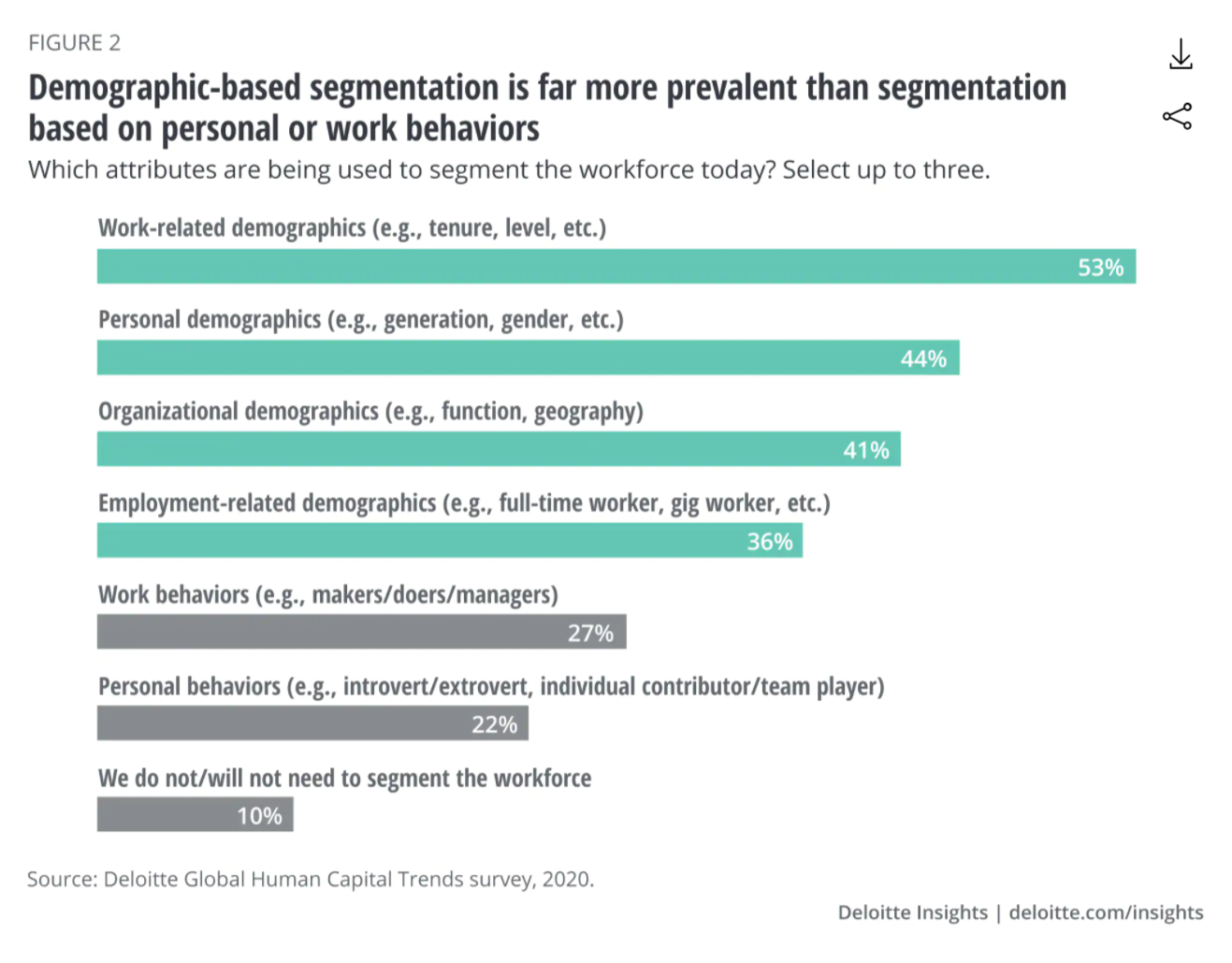
Too much focus on big data means you forget the little guy, the individual in those groups. Demographics like age, seniority, department and gender are data sets that respondents in the Deloitte survey said they’d find valuable and are relied on frequently. But work behaviours, personal attributes, mindsets and attitudes are used far less often!

Deloitte Multigenerational Workforce Insights

Source: Deloitte

Like that potential family reunion we mentioned at the start, the trick is in finding the balance. In discussing the topics that transcend generations and focusing on the things that bring you together, as opposed to what separates you.

Aligning with business goals to drive impact

We mentioned it earlier, but the HR budgets are looking like they’ll be trimmed as we move into 2022! Gartner’s 2021 HR Budget and Staffing Survey revealed that more than a third (34%) of HR leaders are planning to decrease the budget for their HR function this year. Which is double the 17% who said the same thing in 2020.

  • 30% are planning to slash the recruitment budget.
  • 25% will cut L&D spend, the second-highest reduction.
  • Although, interestingly, 37% plan to increase their L&D budget. The second-highest increase behind diversity and inclusion spend.

What the report and this statistical snapshot show us is a mindset shift. While some companies will cut back on L&D to increase spend in different areas, others will do the opposite – and the same applies if we swap L&D for the other topics in Gartner’s list, like HR technology or total rewards.

But the best way to ensure that you’re not affected by these budget cuts or that those cravings for savings don’t hit you in the pocket is to prove your impact and value. This is why aligning with business goals and objectives is a crucial HR trend for 2022.

SAGE research backs this up and really shows an opening for some HR rebranding or relationship management. Here are three takeaways from this study.

  • Alignment – Despite 81% of C-suite executives feeling HR’s priorities are aligned to that of the overall business, 59% said HR are not playing a leading role.
  • Insights – While 94% of business leaders have access to some form of people data from HR professionals, 68% are not fully reliant on them.
  • 62% of HR leaders admit to not being able to use people analytics to spot trends and provide actionable insights to inform business-related decisions.

In summary, C-suite executives don’t think HR is playing a leading role, people leaders aren’t using people data and even HR leaders are struggling to spot trends in the numbers that allow them to influence business decisions.

Which steps can HR take to align with business objectives better?

So, how does HR turn this around! One step is to start acting more like performance consultants, to diagnose problems before prescribing solutions. Speaking with senior leaders to understand their goals and pain points makes it far easier to align HR activities with those objectives.

And if you’re lacking that data analytics talent in your team, think about upskilling someone (or bringing somebody in) to crunch those numbers and help you spot trends. For example, if you’re noticing a particular pattern in when people leave the company or the lack of an in-demand skill, you can help others see the value in people data.

The same Gartner survey revealed that 34% want to increase spending on HR technology, but you’ve got to convince them it’s worth their time and that they should invest more in the people behind the tech too. And speaking of HR tech, we’ve got the perfect guide for building your winning stack right here.

Diversity and inclusion initiatives

Wait, didn’t HowNow include that in their 2021 predictions? We did! But the numbers tell us not only were we right (who doesn’t love hearing that) but that we’re well advised to pop it in for 2022.

We’re back with another Gartner stat, this time that a massive 45% of HR pros plan to spend more on diversity and inclusion and 46% will maintain their previous budget – meaning just 9% will scale back on D&I spend.

The second annual HR Sentiment Survey conducted by Lyra Health, Boston University and Future Workplace backs this up, naming DE&I as the second-highest HR priority. Only employee wellbeing and mental health finished above it, in their survey of 200 senior HR leaders across the US.

But it’s not an initiative that HR can lead alone! First of all, there’s the understanding issue; according to Ideal, “70% of companies believe they are effective at attracting and retaining diverse employees, yet only 11% actually understand what it is.”

So, the messaging has to be right and everyone needs to be on the same page. Speaking of which, it’s helpful if senior leaders are showing commitment and passion when it comes to D&I. More importantly, it needs to fit with your brand and your people – for example, simply sending people on a one-day unconscious bias training course could feel like a token effort to some and rub sceptics up the wrong way given that its impact has been heavily questioned in recent times.

Rather than searching for solutions as your starting point, channel that inner performance consultant we mentioned earlier and speak openly and honestly with your people before acting.

The revamping of employee perks and benefits

Employee benefits really went through a weird phase in the 2010s. At the midpoint of the decade, it was a surprise to find room for any desks with all the ping pong tables, beer pumps and free pizza (normally on Fridays) that were on offer.

Once they were old hat, it seemed to spark a race to offer the weirdest perks, and we reached the likes of nap pods, free SCUBA certification, a ‘posh bog roll’ guarantee and even botox injections.

Hopefully, people didn’t take up that last offer because 2020 and 2021 taught us two things: there’s plenty to frown about, and employee perks like this are pretty much redundant.

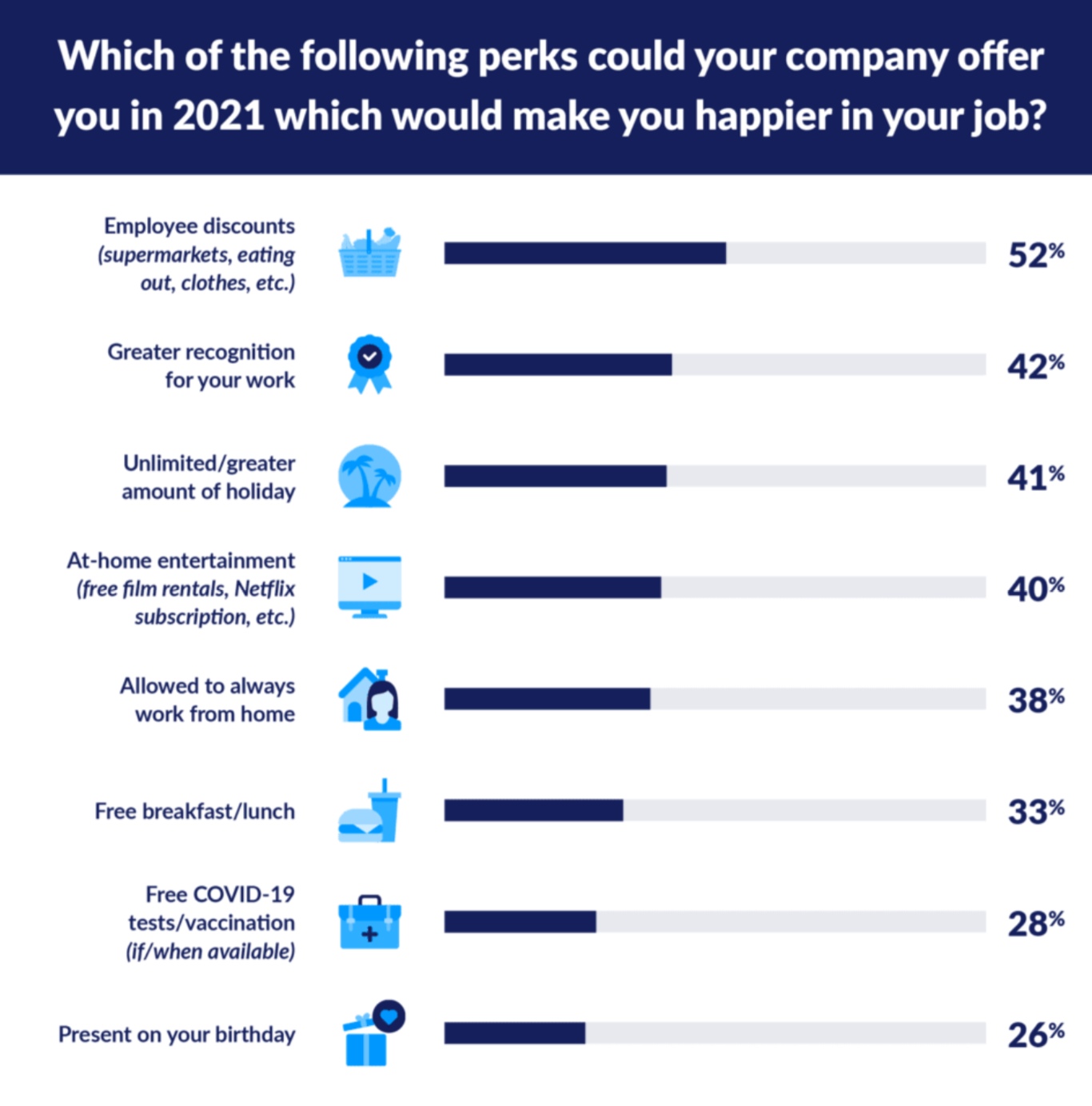
Perkbox surveyed 1,532 UK employees to find out what perks they want in 2021 and the findings were quite interesting. None of the perks people named as making them happier in their job were explicitly linked to being in the office – although sending a free breakfast to every employee working remotely might be tricky.

Perkbox 2021 Employee Desired Perks

Source: Perkbox

Work-life balance really sums up the theme here. People want discounts or subsidies on the personal things they’re doing outside of work, they want to travel more often and head into the office less often, and they want recognition for their hard work even if they work from home!

In fact, a recent study from Kansas State University and the University of Mississippi’s Novak Leadership Institute revealed that younger workers are concerned about how their managers treat them. In particular, there are two types of respect they crave:

  • Being valued as a team member.
  • Being respected as a person who has a life outside of work.

Back to our Perkbox survey briefly, when asked about benefits that would improve wellbeing, more flexible hours, mental health days and free counselling sessions joined some of the perks in the happiness list.

50% of non-remote employees want contributions towards household bills and 46% for their home office equipment, while those heading into the office surprisingly named free breakfast and lunch as their top priority.

Yet only a quarter want subsidised commuting costs, which you’d imagine would be far more helpful than a fry-up on Fridays. But maybe the way to your employee’s hearts is through their stomach after all.

Want a 5x better engagement than a traditional LMS
Demo Hownow

Be in the know

More articles

Overview: Based on reviews from learning platform users, Sana Learn is praised for its intuitive interface, easy adoption, engaging interactive content, and AI-powered tools that can speed up content creation and discovery. Customers consistently highlight smooth onboarding, responsive support, and useful integrations with email, calendar, and collaboration tools. However, recurring limitations emerge around content flexibility, AI accuracy, occasional technical glitches, UI quirks, and gaps in admin training, which can create friction as teams scale their learning programs. While Sana Learn works well for organisations seeking fast rollout and straightforward learner engagement, teams needing more customization, reliable AI, and robust integrations may want to explore alternative platforms and see how they compare in practice.


When you're evaluating learning platforms, everyone has an opinion. Vendors have feature pages. Review sites have listicles. And everyone claims to be the best AI-powered LMS on the market.

What nobody tells you is what it's actually like six months in.

Sana Learn (part of Sana Labs), an AI company founded in 2016 in Stockholm, will likely show up early in your research. It's well-funded, well-marketed and has built a genuine reputation in the AI learning space.

But reputation and reality don't always match. And the people best placed to tell you the difference aren't the sales team. They're the L&D leaders, admins and learners who use it every day.

To help you, you’ve analysed 50+ real customer reviews so you don't have to. Not to cherry-pick the bad bits but to find the patterns that will help you make informed decisions. The things that come up again and again once the implementation is done and the day-to-day reality sets in.

Because when you're making a buying decision that affects your entire workforce, what matters isn't which platform has the best copy or demo. It's which one that will help you build and engage your workforce to proactively build the skills your business needs to grow.

Where Sana Learn does well.

One thing becomes clear when you read through the customer reviews: Sana Learn is easy to like.

Users consistently describe the platform as intuitive, clean and simple to pick up. There's very little friction in getting started which, if you've ever tried rolling out a new learning platform to a sceptical workforce, you'll know is no small thing.

That ease extends to implementation. Several reviewers highlight how seamless the setup felt, with teams barely noticing the transition. For organisations without the time or appetite for a heavy rollout, that's a meaningful advantage.

AI is another area where Sana Learn gets genuine praise. Users point to how quickly they can generate content, surface answers and navigate learning materials with AI woven throughout the experience. When it works, it removes friction from the content creation process in a way that L&D teams with limited resources will appreciate.

The learning experience itself also lands well. Interactive modules, clickable elements and embedded content make it easier to engage with topics that would otherwise feel dry. Learners aren't just clicking through slides; they're actually interacting with material.

Put simply: Sana Learn is a platform that's genuinely easy to adopt and easy to engage with. For teams prioritising simplicity and fast time-to-value, that counts for a lot.

What are the limitations of Sana Learn?

Once you move past first impressions, the reviews become more nuanced; and more useful.

A recurring theme is that while Sana Learn is easy to use, it can feel limiting when you try to do more with it.

Several users point to a lack of flexibility in content creation. Editing options are described as restrictive, with one reviewer putting it plainly:

"Tables are a bit clunky and hard to edit… [there's not] much freedom when it comes to text & layout."

Others mention having to rely on external tools to get the output they actually need:

"Many features are unavailable and have to be done outside of the platform using third-party providers."

For L&D teams trying to scale content production or tailor learning experiences more precisely, that's where friction starts to add up.

There's also a subtle but telling critique around product direction. One reviewer notes that the platform sometimes prioritises:

"attention-grabbing features over more basic feature development."

That's the kind of comment that tends to surface when a platform is evolving quickly; but not always in the direction its users need most.

Is Sana Learn's AI reliable?

AI is one of Sana Learn's biggest selling points; but it's also one of its most inconsistent areas.

While some users are impressed by the speed and convenience, others highlight accuracy issues that slow them down rather than speed them up:

"There are times when the AI doesn't fully grasp what I'm asking for…"

"Sometimes the AI suggestions are not fully accurate, and it takes a bit of time to find the exact content I'm looking for."

That tension shows up across multiple reviews. The capability is there; but it's not always reliable enough to trust without sense-checking.

For L&D teams expecting AI to meaningfully reduce manual effort, that gap matters more than it might first appear.

What do Sana Learn users say about technical performance?

Another pattern across the reviews is the presence of ongoing, low-level technical friction. Not catastrophic failures; but enough to interrupt workflows when they matter most.

Users mention occasional platform freezing, performance lags when handling complex content and integration challenges, particularly around APIs. One reviewer sums it up plainly:

"The platform can be a bit glitchy at times…"

Others call out specific integration issues:

"Had some hiccups with [the] Bamboo integration API."

These aren't universal experiences; but they appear frequently enough to be worth factoring in, particularly for organisations running a broader HR and L&D tech stack where reliable integrations aren't optional.


What do Sana Learn users say about the interface?

Interestingly, even though usability is one of Sana Learn's most praised qualities, there are still consistent complaints about specific interface behaviours; particularly once users move beyond everyday tasks.

For example, one reviewer points out a frustrating content creation issue:

"When I'm creating a comment… and then pop over to another window, the comments I started typing disappear."

Others find the home screen experience overwhelming:

"The interface can appear a little overwhelming with all the videos visible when you enter the homescreen."

There are also mentions of difficulty navigating back to in-progress courses, and issues with live learning environments around audio and visual quality.

None of these are deal-breakers on their own. But together they create a sense of inconsistency; where the platform feels smooth in some moments and frustrating in others. For L&D teams managing large learner populations, those friction points tend to get amplified at scale.


What do Sana Learn users say about the learning experience?

Beyond the platform mechanics, some users point to limitations in how learning content is actually delivered.

Quiz functionality comes up more than once, particularly around rigid structures:

"When making a mistake… you have to click through the whole exam before being able to repeat."

Others mention repetitive questions and a lack of depth in supporting materials:

"Example videos are not very detailed enough."

There's also feedback around pacing; specifically that learners can move through content too quickly without meaningful controls in place to slow them down or check understanding along the way.

None of these are headline issues. But for L&D teams where learning effectiveness is the whole point, they're worth knowing about before you buy.


What do Sana Learn admins say about the platform experience?

While learners tend to find Sana Learn straightforward, the experience for admins and L&D teams is less consistently praised.

Some reviewers highlight a lack of guidance when it comes to more advanced features:

"Need more training on available features."

Others point to documentation that doesn't quite hit the mark:

"Videos are usually very short and articles can be text heavy."

This creates a meaningful disconnect. The platform feels simple on the surface; but getting the most out of it as an admin can require significantly more effort than the initial experience suggests. For L&D teams who need to move fast and can't afford a steep learning curve behind the scenes, that's worth factoring into your decision.


Should you be looking at Sana Learn alternatives?

That depends on what you need.

If your priority is fast rollout, strong initial engagement and a clean intuitive interface, Sana Learn clearly delivers. For teams that need something up and running quickly with minimal friction, it's a strong option.

But if you're thinking longer term; about scaling learning, tailoring content more precisely and integrating deeply into your wider HR and L&D tech stack, the limitations that surface across these reviews start to matter a great deal more.

The question isn't whether Sana Learn is a good platform. For many organisations, it is. The question is whether it's the right platform for where your organisation is going; not just where it is today.

Is HowNow a good Sana Learn alternative?

HowNow tends to come up for teams that want more than a clean learning interface.

Reviews give you a strong starting point but they won’t tell you how a platform fits your specific setup.

If you’re weighing up Sana Learn against alternatives, the most useful next step is to see them side by side.

HowNow built around a different idea: that learning shouldn't sit in a separate platform, disconnected from the way people actually work. It should connect everything together; the content, the skills data, the performance context and the tools your teams already use every day.

In practice, that means bringing learning from multiple sources into one centralised place, linking development directly to skills gaps and business performance, and using AI in a way that supports real workflows rather than just speeding up content generation.

But perhaps most importantly, HowNow is designed to scale with you. Not just easy to start; but built to deliver more as your organisation grows, your needs get more complex and your expectations of what good learning looks like get higher.

If the patterns in these reviews resonate with challenges you're already facing, it might be worth seeing it for yourself.

👉 Book a demo here

Sana Learn Reviews: Pros, Cons & What Customers Really Think

Based on 50+ customer reviews, this guide breaks down Sana Learn’s pros, cons, AI capabilities and platform limitations. Discover what real users say about usability, integrations, support and whether it’s the right fit for your L&D strategy.
Comparisons
Apr 10
.
5 min read

Buying a learning platform is a big decision.

You’re comparing features, pricing, integrations, and user experience. But there’s one thing that often gets pushed down the list is security.

It shouldn’t be.

Learning platforms sit on a goldmine of sensitive data e.g. employee records, performance data, personal details. If that data is mishandled, the impact isn’t just technical. It’s reputational, legal, and operational.

So before you get dazzled by a slick demo, it’s worth asking more important questions such as:

Is this platform safe? And can I trust this vendor?

Why security matters when buying a learning platform

Security conversations are often left until the final stages of evaluation.

By then:

  • Data has already been shared
  • Internal stakeholders are invested
  • Walking away feels expensive

That’s how risky decisions get made.

Instead, bring security into the conversation early.

Loop in your InfoSec, IT and data protection teams from the start so they can review vendors alongside you (not play catch-up at the end which is what we often see).

It saves time, avoids friction, and builds confidence internally.

What security certifications should an LMS or LXP have?

There are plenty of badges vendors can display.

Not all of them mean the same thing.

When it comes to learning platform security, there are two certifications that actually matter:

ISO 27001:2022 — The Global Standard

ISO 27001 is a globally recognised information security standard.

It’s a risk-based framework that shows a vendor takes security seriously across their organisation (not just in isolated areas).

But this is where many buyers stop too early.

The certificate alone isn’t enough.

Ask for the Statement of Applicability (SoA).

This document shows:

  • which controls are implemented
  • how risks are managed
  • why specific decisions were made

When reviewing it, pay close attention to:

  • information classification
  • data leakage prevention
  • handling of personally identifiable information (PII)

Learning platforms process large volumes of employee data. If a vendor can’t clearly explain how that data is segmented and protected in their cloud environment, the certification doesn’t mean much.

What to double-check

  • Does the certification cover the whole organisation or just part of it?
  • Is it officially accredited?
  • Is it the vendor’s certification, or are they pointing to their hosting provider (AWS, Azure, etc.)?

If it’s the latter, push back. Hosting infrastructure doesn't mean application security.

Cyber Essentials Plus — Essential for UK-based organisations

If you’re a UK-based company, Cyber Essentials Plus should be your baseline.

Unlike the standard Cyber Essentials (which is self-assessed), the Plus certification includes:

  • independent technical verification
  • hands-on testing
  • real validation of controls

For a learning platform handling sensitive employee data, this provides confidence that the basics are properly secured.

As with ISO 27001, don’t just take it at face value.

Verify it:

Security checklist for evaluating any LMS vendor

Even with the right certifications, you should go further.

Here’s a simple checklist you can use internally or share with your IT team:

Before approving a learning platform, confirm:

  • ISO 27001:2022 certification (with SoA available)
  • Cyber Essentials Plus (if UK-based)
  • SSO support (e.g. Okta, Azure, Google)
  • encryption at rest and in transit
  • data classification and leakage prevention controls
  • penetration testing summaries
  • disaster recovery and business continuity plans
  • incident management and breach response policies
  • data processing agreement (DPA)
  • subprocessor transparency

If a vendor struggles to answer these clearly, that tells you something.

Questions to ask your LMS vendor

If you want to quickly separate strong vendors from weak ones, ask:

  • Can you share your Statement of Applicability?
  • Does your ISO 27001 certification cover your entire organisation?
  • How do you protect PII within your platform?
  • How do you prevent data leakage in your cloud environment?
  • Can you verify your Cyber Essentials Plus certification?
  • Is your certification your own, or your hosting provider’s?

HowNow’s approach to learning platform security

At HowNow, security isn’t an afterthought. It’s built into every layer of the platform.

We’ve designed our approach to make life easier not just for L&D teams, but for IT and security teams reviewing us too.

Our compliance framework includes:

  • ISO 27001:2022 for information security management
  • ISO 9001:2015 for quality and continuous improvement
  • Cyber Essentials Plus for independently verified technical controls
  • GDPR compliance and data protection standards
  • NIS2 readiness and evolving regulatory alignment

We also provide full transparency through our Trust Center, including:

  • encryption standards (including AES-256 at rest)
  • SSO and identity provider integrations (Okta, Azure, Google, etc.)
  • penetration testing summaries
  • vulnerability management policies
  • disaster recovery and business continuity plans
  • subprocessor details and data handling practices
  • AI security and ethics policies

👉 Explore the HowNow Trust Center: https://trust.gethownow.com/

This gives your IT and security teams everything they need to evaluate us properly without delays or back-and-forth.

The bottom line:

A great learning platform should help your people perform better.

But it also needs to earn your organisation’s trust.

Security credentials might not be the most exciting part of the buying process but they’re one of the most important.

The right certifications, combined with real transparency, give you confidence that your data is protected and your decision is sound.

Bring your IT team into the conversation

If security is slowing down your buying process, you’re not alone.

The easiest way to move forward is to involve your IT and security teams early and give them direct access to the information they need.

Share our Trust Center with them or book a call with our team to review everything together.

No chasing. No vague answers. Just clear, honest security information.

Which Infosec Credentials Should You Look for When Buying a Learning Platform?

Blog
March 30, 2026
.
5 min read

Learning Technologies is back and we could not be more excited.

L&D is changing faster than most organisations can keep up with. AI is reshaping how people learn, skills gaps are widening and the pressure on L&D teams to prove impact has never been higher. The conversations happening at this year's event are going to matter.

HowNow is already working with companies to build the talent of tomorrow; closing skills gaps, connecting learning to performance and giving L&D teams the data to prove it's working. We want to help you do the same.

Learning Technologies is a great place to start this journey.

You'll find us at stand E30. Come and find us.

Here's what's waiting for you.

1. Get a Free Learning Health Check

Most L&D teams we speak to already know something isn't quite working. Maybe engagement is low. Maybe learning is scattered across too many tools. Maybe the business is asking questions about impact that are hard to answer.

The Learning Health Check is a free 15-minute desk-side consultation with one of our experts at stand E30. No slides, no sales pitch; just a focused conversation about where your organisation is right now, what's getting in the way and where the biggest opportunities are.

You'll walk away with tips you can apply to your strategy straight away, whether you use HowNow or not. This is exclusive to Learning Technologies and designed to be relevant to you and your organisation.

2. Hear How to Prove Learning Is Actually Building Skills

Day one. 1:10pm. Bitesize Stage

If you've ever sat in a leadership meeting struggling to demonstrate the impact of your learning programme, this one's for you.

Harvey Stead is taking the stage for a bitesize session on one of the biggest questions in L&D right now: how do you prove that learning is genuinely building skills? Join a group of 30+ L&D leaders for a practical, focused conversation designed to give you something you can actually take back to the business.

Arrive at 1pm to secure your seat. Spaces are extremely limited and assigned on a first-come, first-served basis.

3. Learn What It Means to Be a Self-Improving Company

Day one, 2:45pm in Theatre 2. 

Every company wants the same thing: people continuously getting better at their jobs. But running that loop manually is nearly impossible. Who's struggling? When do you intervene? What actually helps? Did it work? By the time you've coordinated answers to those questions, months have passed and the moment is gone.

In this session, Nelson Sivalingam; CEO of HowNow, one of the fastest-growing AI learning companies and author of the acclaimed book Learning at Speed; introduces a fundamentally different model: the self-improving company.

Nelson will show how AI agents are transforming organisational performance by monitoring work systems in real time, detecting struggles the moment they emerge, intervening with the right support at the right time and measuring what actually improved in performance data; not surveys.

4. Hear Directly from Trainline on Linking Learning to Business Outcomes

Day two, 11:45am in Theatre 2. 

Proving the business impact of learning is one of the hardest things L&D teams are asked to do. Most organisations know learning matters; getting the data to prove it to the business is a different challenge entirely.

This is the session for anyone who's ever had to make that case internally.

Trainline will be on stage sharing exactly how they've connected learning to real business outcomes; the approach they took, the challenges they faced and what the results actually looked like. No theory, no vendor pitch; just a peer in the same shoes telling you what worked.

If you're trying to win more investment for L&D, build credibility with your leadership team or simply understand what good looks like in practice, bring a notebook.

5. Meet HowNow Customers at Our Happy Hour

Our customers will be joining us at Learning Technologies and we would love to introduce you.

Straight after Nelson's session, we're hosting a customer meet and greet at stand E30. Prosecco, canned cocktails, beers and the kind of conversations you actually come to events like this for.

Want to know what it's really like to use HowNow? Don't ask us. Ask them.

Look out for the special 'talk to me' badges; those are the HowNow customers with the real stories. They'll be in and around the stand all afternoon and they're easy to spot. Pull them aside, ask them anything and hear first-hand what's working for organisations just like yours.

6. Start Day Two with Breakfast on Us

Day 2. Stand E30.

Come and find us first thing on day two.

We'll have coffee, croissants, Danish pastries and muffins waiting; and it's a great chance to have a relaxed conversation with the team before the day gets going. No agenda, no pressure; just good food and good company.

The best conversations at events like this often happen before the programme even starts. And we will provide food for thought… literally.

And so many more reasons….

So, whether you want to catch a talk, grab a drink, or just have a proper conversation about your learning strategy, we'd love to see you. Learning Technologies is one of the best opportunities of the year to connect, learn and get inspired and we're making sure our stand is worth your time.

See you there.

6 Reasons to Visit HowNow at Learning Technologies 2026

Blog
March 18, 2026
.
5 min read

Onboarding is one of those things everyone agrees matters and yet it’s still one of the most inconsistently done processes in most organisations. Too often it’s a chaotic first week of back-to-back meetings, a SharePoint folder nobody can find, and a laptop that arrives three days late.

Designing onboarding that actually scales is one of the biggest challenges HR and L&D teams face. Most organisations know their onboarding could be better. 

Pauline Taylor, VP of People at HowNow, spoke with Ian Walker on the L&D Disrupt Podcast about what great onboarding really looks like and how to build it properly.

This blog walks you through what came out of that conversation and where to start.

Why Onboarding Matters More Than You Think

Let’s start with the business case, because it’s a strong one.

As Ian puts it:

“The value, of course, is that you are accelerating people’s sense of connection. And the statistic about that is that if people feel that they have been treated well in the onboarding process, their longevity is extended. So from a retention point of view, the evidence is pretty unequivocal.”

Connection drives retention. If a new hire spends their first few weeks feeling lost, anxious, or like an afterthought, you’re already on the back foot, regardless of how good the role is. Good onboarding accelerates that sense of belonging and gets people up to speed faster. Friction in those early weeks doesn’t just feel bad. It costs you time, productivity, and ultimately, people.

Want to learn how to create an onboarding process? Check out this blog on how to create an onboarding process.

Should Employee Onboarding be In-Person vs. Remote?

There’s no universal answer here, but there are some useful principles.

If you’re onboarding in person, you’re making a strategic investment in culture. Salesforce, for example, made in-person onboarding a priority specifically because they believed it was the best way to embed culture from day one. That’s not a logistical decision; it’s a values one.

If you’re onboarding remotely, the goal is to make the experience feel as close to in-real-life as possible. As Ian says:

“Similarly, if you’re doing it remotely, make sure that all of the experience is as far as possible close to the in real life experience.”

The principles are the same: connection, culture, and clarity. The delivery just looks different.

Nail the Employee Onboarding Fundamentals

This one sounds obvious, but it’s where so many onboarding programmes fall apart.

If you’re bringing someone in person, the infrastructure has to be invisible. Ian is direct on this:

“If you’re gonna do it in person, make sure that all of that is properly handled and does not come back onto the individual. Not only will that distract them, it’ll make them more nervous, it’ll make them feel less good about the whole experience. But it will detract from the efficiency of ramping them up quickly as well.”

That means flights and hotels booked correctly, a laptop ready on day one, security badges sorted in advance, and schedules organised. Get the admin right, and everything else has a chance to land.

What Should Actually Be In Your Onboarding Programme?

Your company culture is the most important element of any onboarding programme. Don’t just list your values on a slide and move on. Bring them to life.

Ian’s advice here is clear:

“Bring in managers, bring in people who are living the culture. So it’s not just someone listening to the same person, same voice all day. You’re getting different voices in there, but you’re getting people sharing their lived experience of why is this culture important to me?”

When people share their lived experience, it lands differently. It’s personal, it’s real, and far more memorable than a PowerPoint.

Networking opportunities

When you’ve got a cohort of new starters in a room (or on a call) that’s a real opportunity. Ian puts it well:

“Use this opportunity to build your network as well. Understand what’s happening within the company because not only will you leverage those relationships, but you’ll learn about what are potential career paths that you can also follow?”

Build in time for people to actually connect with each other. Those relationships can shape how people collaborate and grow within the organisation long after onboarding ends.

Setting real performance expectations

Be upfront about what working there actually looks like. Ian recalls:

“I remember talking to a room full of newly hired employees and saying, you’re gonna be expected to work hard. And you could see these big eyes — and it’s like, yeah, it’s just a reality. You are gonna be held to account for what you do. So expectation setting early on, I think, is really key.”

Ideally, it starts in the interview process, but reinforcing it early avoids misalignment down the line.

The big picture

Help new starters understand how the company works from top to bottom. As Ian explains:

“If you can explain from a top level down, this is a corporate objective, this is what we try and accomplish, this is how it cascades down within each team and each department — how it all fits together and what role you play in it — people get the sense of the bigger picture they’re playing within the organisation as well.”

When people understand how their work connects to something larger, they’re more motivated and more effective.

The Triangle: Getting the Handoff Right

This is one of the most important (and most overlooked) parts of onboarding at scale.

Onboarding isn’t one team’s job. It’s a shared responsibility across three groups:

  1. The onboarding team: responsible for culture, company-wide knowledge, and the rites of passage every new starter goes through
  2. The enablement or L&D function: responsible for the functional knowledge someone needs to actually do their job
  3. The manager: responsible for supporting the new hire and integrating that learning into day-to-day work

Ian is emphatic about how closely these three need to work together:

“The enablement organisation and the onboarding organisation need to be in a triangle. A really close triangle. So that the handover is happening effectively. The knowledge is being built upon. It’s not being duplicated. Nothing worse than when someone’s being invited to one call for onboarding and then they’ve been invited to an enablement call. You can’t allow that to happen. It has to be sequential and it has to be managed collectively.”

When this triangle breaks down, the new hire falls through the gaps. When it works, everything flows.

Onboarding is a Two-Way Street

Onboarding isn’t something that happens to a new hire. They have a role to play too. As Ian puts it:

“The fourth person is the learner themselves. They need to invest the time in order to onboard themselves effectively. So they need to read the materials, do the out of the room learning piece, as well as relationship building out of the room as well, which is so key to onboarding effectively.”

Setting that expectation early makes a real difference. People who take ownership of their own onboarding get up to speed faster and feel more settled sooner.

How Long Should Onboarding Last?

There’s no magic timeline that works for every role, every person, or every organisation. The length of onboarding depends on the complexity of the role, the individual’s prior experience, and how transferable their skills are.

What Ian suggests is a more interesting reframe altogether:

“You should always feel that you’re onboarding because you are always in your job. And particularly now, jobs are changing so quickly that if you have that beginner’s mindset, you are always onboarding yourself in a new direction. If you are always growing yourself.”

The most effective people don’t stop onboarding when week four ends. They carry that curiosity with them.

The Summary

Great onboarding isn’t about cramming as much information as possible into someone’s first week. It’s about connection, clarity, and getting the fundamentals right so people can do their best work sooner.

Get the logistics sorted. Bring culture to life. Build the triangle. Give new starters the space to take ownership. Resist the urge to put a fixed time limit on it.

Want to hear the full conversation?

Watch on YouTube


Listen on Spotify

Other relevant blogs:

The HR and L&D How-To Guide for Designing Onboarding That Actually Scales

Podcast
March 9, 2026
.
5 min read
Modern L&D
made simple.
Connect with an expert to explore what's possible with HowNow.
Request a demo